A Introduction
You may be forgiven to think that in today’s modern world, the reincarnation of the devil is likely to manifest itself through technology. Indeed, the treacherous power that technology bestows upon those who control it can be alarmingly dangerous. It gives access to terabytes of data, knowledge, and information (Big Data) that can be analysed by sophisticated algorithms (AI), and which can in turn be used to influence people’s attitudes and behaviours. What more can the devil want? The Cambridge Analytica scandal is still fresh in our minds. I am sure you remember the case. The company had acquired unauthorised access to personal data of millions of Facebook users. Wikipedia claims that such data was used to influence the presidential campaigns of Ted Cruz and Donald Trump in 2016. Cambridge Analytica was also accused of using its data to influence the outcome of the Brexit referendum.
There is no doubt in my mind that technological advancements have in general left a positive global imprint on a political, economic, social, and environmental level. In most cases, it has made our life easier and better. But do not be misled. Businesses in general invest in technology to create chaos to their advantage. There is no harm in that. In fact, for most start-ups, it is the only way to build a successful business. Every day we get to hear about a new technological innovation that is launched into the marketplace. Not all are ground-breaking. In fact, most of them fail. But some exceptions not only survive but become the new gold standard opening new opportunities for organisations to play by different rules in the marketplace. These new breeds of technologies have been branded as “Disruptive Technologies” and form part of what has been called the industry 4.0 revolution.
In practice from my experience, although many organisations are keen to join the bandwagon and invest in these “disruptive technologies” most end up being disappointed by the results. This is not surprising since from what I have seen, most of these organisations simply replace a traditional technology with a disruptive technology to offer more of the same. Most organisations fail to see how these emerging technologies could bring about opportunities to disrupt their business model.
This phenomenon is not something new in the history of technology. We all remember (at least those of us with some grey hairs), the rise and fall of the dot.com bubble when the internet went mainstream. Indeed, the internet gave rise to a pandemic of small start-ups venturing into the realm of eCommerce claiming to be unique alternatives to their traditional brick-and-mortar counterparts. Most of these start-ups were not offering anything new. They simply replicated a brick-and-mortar business model into a virtual space. It was more of the same offered through yet another distribution channel. No wonder that more than 90% of these dot.com start up failed miserably. Anyone remembers Pets.com, Webvan, eToys, Flooz and Drkoop? These companies went into oblivion along with hundreds over other companies despite multi-million-dollar investments made by investors. The real successful organisations reinvented new business models that leveraged the power of technology and data processing offering an enhanced customer experience along with customised content. This is the very essence of success that has made Amazon, Netflix, Facebook and eBay the giants they became today.
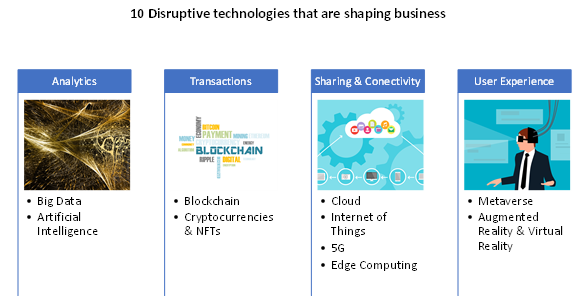
Today, the sheer number of new emerging technologies that are being launched into the marketplace are insurmountable. Keeping track of all developments is an impossible feat. No one however can deny that there are certain technologies that stand out of the crowd, and which are likely to move mainstream in the foreseeable future. From my perspective, however, there are ten core technologies that are expected to revolutionise the way business is carried in the foreseeable future. These may be categorised into four different areas:
B Analytics
Analysing data is an obvious application of technology. In fact, most technologies that are available on the market exist precisely to collect, process, and analyse data to generate information and knowledge for decision-making. As the availability of new datasets and sources of information are growing exponentially, organisations not only need better ways of processing and collecting such data. They also require more advanced tools in interpreting their meaning and learning from them to make informed decisions. In Digital Made Simple, I argue that algorithms are the new gold for business. For this reason, in my view, emerging technologies that are harnessing the power of data analysis, interpretation and learning have great potential to become mainstream technologies in relatively short periods of time. Two core technology groups that have particularly captured the attention of mainstream business include Big Data Analytics and Artificial Intelligence.
Big Data is revolutionary in the sense that it is breaking the boundaries of what volume and variety of data can be analysed at higher velocities whilst ensuring their veracity and value. Reaching these new heights of unprecedented processing capacities enables businesses to make more informed decisions in real time.
Perhaps, one of the most famous and well-known early examples of Big Data application is Hadoop. Hadoop is an open source, java-based system that has the capability of storing and processing big data. The system is structured in a way that enables applications to run large data sets distributed across several clusters of processing units.
Several new applications have been developed since then. Tableau is one case in point. It provides end-to-end analytics for processing, analysing, collaborating, and sharing big data insights across several users in a visual format. IBM has also invested considerably in the development of Big Data Applications. Some examples include Cloudera Data Platform designed to achieve “faster time to value with containerized data services andacceleratet time to insight analysis”1and Cloudera Dataflow (CDF) which is described as a “scaleable, real time streaming data platform that ingests, curates and analyses data for key insights and immediate actionable intelligence.2
Several other applications exist in the marketplace which are too many too mention. More systems are expected to join the bandwagon as many organisations are progressively recognising the value brought about by Big Data. In fact, a survey conducted by the Economist Intelligence Unit among 600 corporate leaders across the globe found a growing appetite for data and, perhaps more importantly, a growing emphasis on data-driven decision making. Organisations are trying to get their arms around the increasing volumes, types and formats of data, from traditional and digital sources, which companies are creating, storing and consuming – what we know as as Big Data – to make informed, forward-looking decisions.
The benefits of becoming a more data-focused decision-maker – and ultimately a more data-driven organisation as a whole – come in many forms and depend largely on the individual company. However, data-driven organisations can generally expect to become more responsive to customer needs and to seize business opportunities that may previously have been hidden from view.
Forbes argues that there are five major benefits that may be generated from Big Data3. These include improved customer acquisition and retention, more focused and targeted campaigns, better identification of potential risks, more effective generation of new products and improved management of complex supplier networks
Having said that, the complexity of the data involved means that there are still major challenges to squeezing all the potential benefits from data management. It is not surprising that the Economist Intelligence Unit has concluded that finding the right people with the right skills is the key obstacle to launching a successful big data project. The same survey also points to the difficulty of interpreting unstructured data – which includes some 85% of all data, everything from the text found in email and on social media sites to machine generated logs as another major challenge.
For those attempting to gain business insights from the data their business is collecting, I would advise that they take the time to reflect and understand their environment, their landscape, where they want to go and what they aspire to be, and engage people that have done this before. Moreover, decision-makers who want to become strategic data planners should begin by gaining a solid understanding of where their data resides. That means looking closely at all of the data sources within the company and creating a plan as to how that information is going to be processed and used.
As I mentioned before, there are great tools out there from a technology standpoint. However, as in most things in business, it’s not just about technology. It’s really about people, technology and process.
2 Empowering knowledge through Artificial Intelligence
Big Data may be considered as the fuel for Artificial Intelligence (AI). Artificial Intelligence has sparked off the battle between algorithms in search for the new gold. Many organisations are seeking to integrate artificial intelligence into their digital strategy. But the road to successful implementation of AI systems is far from simple. The implementation of AI is distinctly different from the implementation of traditional systems.
In the first instance, machine learning systems are the lynchpin for the creation of the cognitive enterprise. This requires a radical paradigm shift in an organisation’s strategy, structure, systems and processes. Moreover, unlike other digital programmes which have a finite duration, machine learning systems require implementation support in perpetuity because “they never stop learning”. Whilst the value of traditional systems decrease over time due to technical obsolescence, the value of machine learning solutions appreciates exponentially as they accumulate experience and “learn” to perform their intended tasks in a better way. The real challenge of organisations is therefore not to implement AI and ML solutions in a live environment, but to create an environment that will support them to continuously learn and improve.
Secondly the breadth of AI applications that have been made available in the marketplace have branched off to focus on natural language processing (NLP) and sentiment analysis. Natural language processing provides a means through which speech and text can be generated or codified through information systems. On the other hand, sentiment analysis can interpret the feelings and experience of data converted through NLP.
Financial services industries are prime candidates for reaping the benefits from artificial intelligence. Financial services operate in a minefield of fast-moving data that needs to be processed, validated and converted into knowledge. But implementing Artificial Intelligence requires more patience and time than that required to implement other solutions, since its true benefits are felt as algorithms progressively learn their own patterns of business.
More recently, we have seen the rise and growing popularity for the use of robotic process automation (RPA). I have assisted several organisations in implementing RPA systems in their overall operations. RPA systems have many benefits for organisations in that they learn over time how to perform tasks and interact with other systems more efficiently leading to significantly better outcomes. One of my banking clients wanted to evaluate how RPAs could potentially be applied to their customer due diligence process. More automation could be achieved by effectively linking an off the shelf AML/FT software, to a proprietary system collecting requisite customer data and documentation submitted by the client and subsequently integrate it to a risk evaluation system that would eventually generate a risk score.
The use of RPAs can be a great means for automating complex tasks that need to be performed by an organisation. However, the priority of organizations should be to simplify tasks and automate processes through simple solutions rather than use complex systems to automate complex processes.
C Transaction Processing
It is no secret that information systems provide tremendous opportunities for businesses and society in general to carry out transactions in a virtual environment. In fact, on-line transactions are progressively replacing traditional channels. The Guardian predicts that in the UK alone, cash transactions will only represent 6% of the total payments.4 SplitIT estimates that in 2019, e-commerce sales amounted to around US 3.5 trillion globally.5 The transition from the physical to the virtual environment that has taken on the world by storm however is old news and has long been the source of disruption for many industries. But the next big wave of technological chaos that businesses will have to grapple with has more to do with the way in which transactions are processed rather than with the eventual dominance of the virtual world over the physical environment. Indeed, transaction processing is in for a massive shakeout as we will progressively witness a transition from centralised transaction processing to decentralised and/or distributed transaction processing. In the next section, I will describe the high-level implications of Distributed Ledger Technologies (DLT), Cryptocurrencies and Non-Fungible Tokens for business which are all primed for making this transition happen.
3 DLT for decentralised decision making & improved ecosystem management.
Distributed ledger technology (DLT) is based on the democratisation of the decision-making process across an entire network of stakeholders. It implies shifting towards ecosystem thinking effectively eradicating organisational boundaries across supply chains. In its purest form, DLT can disrupt not only organisational ecosystem management but also the way in which society itself is organised. For civilisation is based on the basic principle that it is more efficient for rules to be created and decisions made by the chosen few than made collectively by the whole.
This concept has manifested itself in several ways. In Monarchies, Kings and Queens ruled by right of blood. In Dictatorships, decision making power is vested in the hands of those having the greatest military power. But even Democracies are not fully democratic. In Democracies, people choose who will rule them, but they rarely decide on what those rules should be. At best they can influence those decisions by holding those chosen to make such decisions accountable.
In organisations, the same principle manifests itself through the concept of stewardship. Shareholders own title over the shares and rights over the profits generated by their company. Shareholders elect directors to make business decisions on their behalf. Directors shape the strategy of the company and direct the senior management team to execute the vision. Shareholders do not make business decisions unless they elect themselves as directors.
The feasibility of stewardship in both societies and organisations is based on two core factors. In the first instance, decisions are characterised by a high transaction cost. The more people involved in a decision, the higher the cost is incurred on such a decision. Imagine Parliament holding a referendum for each bill that would need to be passed as law. The time, effort and cost to be incurred would be phenomenal! The same principle applies for organisations. Holding a general meeting for shareholders to purchase a few items of office furniture would clearly not make sense.
A fundamental characteristic of distributed ledger technology however is that it brings transaction costs associated with decisions made across a multitude of nodes in a network close to zero. Essentially, a transaction or a decision (through a smart contract application) is confirmed if more than 50% of the nodes within the network confirm the transaction or endorse the decision in real time. In addition, blockchain provides full traceability of all decisions, immutability, enhanced security, consensus and fast settlement. Indeed, the technology is available to make centralised decision making redundant.
Transaction costs are not the only limiting factor for true democratic decision making. Left on their own, individuals will make decisions based on self-interest such that the collective decisions may not be in the best interests of the whole. At societal level, a tax bill is unlikely to be approved through a pure democratic process even though no one would argue that taxation is an indispensable tool for the wider community. Similarly, shareholders are more likely to vote for a distribution of dividend for all the retained earnings of an organisation which would be otherwise needed for longer term growth.
DLT has the technical capability to significantly alter critical dynamics of decision making at organisational and society level. Democratisation can open doors for building strategic agility in sectors that are typically chained to their legacies. However, given the strength of current norms and corporate cultures, it is unlikely to cause any major dents in their current modus operandi at least in the short term. This would largely explain why blockchain systems have not yet taken off the ground at a rapid pace.
From my experience, the benefits that can be brought about through blockchain systems have been significantly misunderstood. I myself have acted as board advisor to several clients with an ambition to develop their own business based on a blockchain system. In particular, I was asked to review various whitepapers of start-ups in the block chain space claiming to “disrupt” their industry “using distributed ledger technology”. Many of these incumbents have missed the point. Yes, DLT is disruptive in that it uses a “distributed” approach to processing transactions in comparison to a “centralised” approach used by traditional systems. But simply replacing a centralised system with a distributed system does not make your business model disruptive. Like most of the dot.com companies of the early 2000s that have perished, it simply offers more of the same using a different technology.
Hopefully, aspiring start-ups developing new business models with an underlying blockchain technology have learnt their lesson. Perhaps in the immediate future, we might see some tangible use cases in supply chains particularly in sectors such as food and pharmaceuticals which require high levels of traceability from farm to fork.
4 Cryptocurrencies, non-fungible tokens and decentralised finance are progressively moving mainstream
Cryptocurrencies have had their fair share of bad publicity. In its early days, Bitcoin was viewed as the go to currency for money laundering, trafficking of arms and drugs and financing of terrorism. In reality, a report prepared by Chainsanalysis in 2020 revealed that only around 0.34% of cryptocurrency transactions arose from criminal activity. This is a far cry from the media and political hype that was created for the past decade. Cryptocurrencies are here to stay and there is no stopping them. They are however evolving and taking on different forms creating a better version of themselves. From Bitcoin (based on proof of work), to Ethereum (based on smart contracts and proof of stake) to Tether (based of the Stable Coin Concept) cryptocurrencies are still battling it out in a quest to become the gold standard. But the evolutionary process has also created Non-Fungible Tokens (NFT) considered to be a new species that have taken a life on their own. NFTs are different to cryptocurrencies in that they are uniquely identifiable to a specific owner. NFTs provide enhanced security features required to tokenise real world assets such as art and real estate. The market for NFTs grew vertiginously from around US$ 80 million in 2020 to a staggering US$ 17 billion in 2021.
In response to growth in these digital currencies, a new generation of decentralised finance (DeFi) applications are emerging. These applications capitalise on the benefits of cryptocurrencies and NFTs by eliminating intermediaries and allowing customers, service providers and supplies to carry out transactions through emerging technologies and peer to peer financial networks.
Given their market volatility, the use of digital currencies has largely been restricted to financial markets and has not yet reached widespread acceptance for use as a medium of exchange for products and services. But the die has been cast and before long businesses across several industries will need to adapt their processes, policies and procedures to accept these innovation digital currencies as a form of payment.
D Sharing and Connectivity
The power of transactions, data, information and knowledge in creating business value is amplified exponentially through network externalities. Opportunities for generating network externalities are enhanced through better, improved, fast and efficient connections across multiple users and devices. A vital feature of sharing and connectivity is to have the necessary trust and peace of mind that data, information and knowledge will only be stored and shared and transactions processed among the intended recipients. Several technological developments in the recent past have made these activities cheaper, easier and safer for organisations leading to the rise of Software as a Service (SaaS), Real Time Performance Analytics and Omnichannel Marketing amongst others. In this section, I will be discussing some of the most promising disruptive technologies that are making this transition happen.
5 IoT has made data flows travel faster and in real time.
If there were only two words that can accurately describe the benefits and purpose of Internet of Things (IoT), it would be communication and action. In simple terms, IoT brings together a series of sensors, actuators and the internet (along with several other elements) enabling different forms of devices to communicate interactively with each other whilst responding to changes in the environment. Whilst sensors convert a physical input into an electrical output (data collection), actuators do the precise opposite by converting the electrical output into a physical response (action). The principle may sound rudimentary. Yet it is the basis of so many revolutionary changes in different markets and industries. Through IoT applications, organisations are gaining access to data faster, cheaper and often in real time. Applications using IoT as an underlying technology have helped organisations optimise their logistics, improve plant performance through predictive maintenance as well as track movements of assets and stock in real time.
One example of the use of IoT in business is an innovative concept for the design of a Smart Complex that I had jointly defined with a client in the real estate sector. People visiting the complex for the first time have limited familiarity with the environment, available facilities and potential opportunities that are presented to them at any point in time. Similarly, vendors and event organisers may be unaware of what type of people are visiting the facilities and are therefore unable to maximise the potential sales and/or events that could be generated that would fit the specific needs of such visitors. The proposed concept sought to address the overall enhancement of the user experience within such contained environments using a mix of technologies including data capture through IoT sensors and Big Data management, geo-fencing for boundary control applications, the use of analytics through AI capability and efficient information, ownership and transaction exchange through a blockchain based protocol and underlying applications. This mix of innovative technology enabled the build-up of real-time operational knowledge and the predictive capability to execute actions effectively within the complex and through the operators and customers themselves. The success of the technological solution is based on the interaction between a range of sensors and devices. These include customers’ mobile devices, portable and fixed consoles, a variety of tags and sensors such as customer identification, smart tokens, vehicle characteristics, RFID tags, facial recognition scanners, CCTV and ANPR readers and IoT Enabled Smart Route Technology amongst others.
Major advancements in IoT has led to the proliferation of a myriad of wearable devices that can help us as consumers to create a better version of ourselves. The question is can we become healthier, more active and above all happier by leveraging the benefits of several apps and IoT devices that are readily available in the market-place? I must confess that I am myself guilty of having become addicted to some of the most popular technological wizardly available as it quenches my thirst for data. Yes I am obsessed with numbers. How much time does it take me to complete a 5K run? What is my average resting heart rate and what is its variability? For how long I remain in a “Deep Sleep” state and what is my average conversion rate of Oxygen into Carbon Dioxide. Welcome to the world of wearable technology which is progressively diffusing from the professional sport/athlete industry into the more mainstream consumer markets.
The fact remains that technology has made it possible to measure our vitals in real time enabling us to monitor our progress. Other forms of technologies that are gaining prominence in the market-place include machine learning enabled fitness coaches that adapt your workouts to suit your specific physical fitness levels achieved based on a set of manual responses and feedback. There are several apps in the market. Pcmag.com presents a range of best work out apps for 2021 (The Best Workout Apps for 2021 | PCMag.) Most of these Apps combine workouts, music, motivation and nutrition recommendations and guidance to enable you achieve a holistic solution for your physical health.
Notwithstanding the variety of the Apps that are available in the market, it is indeed surprising to note that so far, they have achieved limited integration with wearable devices thereby relying mainly on user feedback and responses. Indeed, I believe that the integration of IoT devices with Fitness Coaches will radically shape the fitness consumer market in the next months. Moreover, a further revolutionary development in the industry could be the enhancement of the data sensing process through global integration of data points (in an anonymous format) relayed through wearables across a spectrum of health-conscious consumers. This would enable active users to benchmark their fitness levels and in turn fitness coaching apps to enrich their access to data thereby “learning” at a faster rate and improve the quality of work out recommendations to its customers. Moreover, taking this a step further, we have already seen the sporadic use of wearables connected to health care providers enabling them to monitor the health of their patients particularly those with heart problems. The widespread use of wearables amongst consumers combined with the power of Artificial Intelligence could indeed provide vital data to health care service providers that could save lives.
Of course there are data protection and ethical issues that would need to be addressed particular in view of the very sensitive nature of the information being collected. Access to health-related data is indeed a very delicate subject with consumer’s privacy and confidentiality being of central importance. Such issues also have to be considered within the context of the recent regulation issues by the European Commission that has laid down harmonised rules on the ethical use of AI in collecting and analysing data. In this context, Blockchain through its Distributed Ledger Technology (DLT) could provide the right safeguards for protecting consumers since data is not retained in a central database but is diffused across several nodes in the network.
6 Cloud Computing for enhanced scalability, efficiency and data accessibility
If the benefits of IoT can be described in two words, those of cloud computing can be summed up into one word. There is no doubt about it, that the biggest contribution of cloud computing is flexibility. In a world where change has become a constant, flexibility has become a vital ingredient for business to success. Cloud computing involves any service that can be readily hosted on the internet thereby being made available to customers anytime and anywhere. Cloud services include: Infrastructure as a Service (Iaas), Platform as a Service (PaaS) and Software as a Service (SaaS).
Infrastructure as a Service (IaaS) typically provide storage, service and network resources to clients through virtual machines. Typical features of of IaaS include automated administrative tasks, dynamic scaling, platform virtualisation technology GUI and API-based access and internet connectivity. The largest global providers of IaaS comprise Amazon Web Services, Microsoft Azure, Alibaba Elastic Compute Service, Google Cloud and IBM Cloud.
Platform as a Service (PaaS) involves the provision of hardware and software tools to clients through the use of an internet connection. Such tools are typically hosted on the physical infrastructure of the service provider who is in turn responsible to carry out maintenance and provide support to ensure continued uptime availability. Key providers of PaaS include AWS, Engine Yard, Google Cloud, Heroku and IBM Cloud.
Software as a Service (SaaS) entails the provision and distribution of software applications to clients which are hosted, maintained and upgraded on the physical infrastructure of the supplier and made available to end users of the internet. The largest global SaaS providers include Adobe, Atlassian, Freshworks, Google and Microsoft.
In my view, cloud computing has defied the dynamics of most industries by giving access to smaller players to benefits of economies of scale of investments in physical infrastructure and systems at a level which was not previously possible. Cloud computing facilitates scalability of data infrastructures with limited upfront investment requirements and access to data securely anytime anywhere. Cloud computing benefits from economies of scale through the development of large physical infrastructures which are then shared remotely through a large pool of users from different organisations.
According to Forbes6, cloud computing is disrupting industry on two levels. In the first instance, the technology industry itself is being heavily impacted by the availability of significantly cheaper applications and access to infrastructures that would not otherwise have been possible for small organisations with tight budgets. Forbes cites Cycle Computing as a case in point. Secondly, budding entrepreneurs have been given access to a broad range of tools available on the cloud at a very cheap cost to drive their innovations with sufficient impact to challenge established players in the market.
7 5G is connecting the world in real time.
Do you remember the old days of dial up connections, snail paced internet speeds and lagging data processing? I do recall the frustration building up as the too familiar hourglass suddenly appearing on my screen signalling me to wait patiently until the data inches through a traditional cable network connection.
Today, the world wide web provides a completely different experience as terabytes of voice and data whisk through easily like a breeze with explosive power through lightning-speed connections. Indeed connectivity has evolved at a fast pace moving from 1G (voice), 2G (Messaging), 3G (Smartphones) to 4G (Audio-visual). Transfer speeds have increased at vertiginous rates from 2.4KBPS in 1 G technology to reach a potential of 10MBPS for 4G.
5G will bring about a radically whole new experience reaching data transfer speeds amounting to 20GBPS. In fact, 5G will be 2,000 times faster than the current 4G technology that we use in our everyday life.
You may be right in asking why higher speed connectivity should bring about any disruption to existing business models. For sure services may be delivered faster and better on-line but is this tantamount to disruption?
In my view, 5G technology will have a massive impact on industries for which real time and immediate access to data and information is mission critical for safe, reliable, efficient and effective delivery of underlying services. At a conceptual level, Ericsson identifies use cases for 5G across five core lenses7. These comprise of use cases developed around a process, a physical object, a physical place, a disruptive technology or industry. On the other hand, Solutions308 identified five industries which are most likely to benefit from the proliferation of 5G technology. These include Manufacturing (machine to machine communication), Agriculture (real time soil and livestock management), Healthcare (Surgical Robotic Aids & Air ambulance drones), Transport (Connected and Driverless Vehicles) and Education (enhanced student experience through better use of virtual reality headsets).
At a consumer level, application of 5G technology is likely to be mostly felt through the introduction of Connected Cars. High Mobility9 defines a connected car as “a Vehicle that is connected to the internet…..It connects via mobile data networks and can transmit data to other devices within or outside of the car”. Indeed, connected cars are expected to revolutionise the whole transportation industry especially once autonomous vehicles are deemed to be safe enough to enter the mainstream market. Connected cars have the capability of collecting and analysing real time traffic and road data and information, process payments, enable location triggered marketing as well as streaming and gaming amongst others. More importantly, connected cars are likely to expedite the move away from car ownership to a car pool sharing model thereby enhancing utilisation whilst reducing capital and operating costs for consumers in general.
8 Edge computing will bring processing capacity closer to the data source
Edge Computing represents an interesting concept that has gained considerable popularity in recent years. Techtarget defines Edge Computing as “a distributed information technology (IT) architecture in which client data is processed at the periphery of the network, as close to the originating source as possible”10 Some believe that Edge Computing is a sub-set of Cloud Computing. Others contend that it is a competing rival that will replace the existing and more widespread use of the Cloud. This is largely because Cloud Computing is based on a centralised model and characterised by high processing power, high latency and large volumes of storage capacity.
Capgemini contends that by driving processing capability at the edges, business stands to enhance customer experience through “personalisation, contextualisation and timeliness”11 On the otherhand, Forbes identifies several ways in which edge computing could be highly beneficial for business.12 These include improved healthcare device performance, local real time retail data analysis, enhanced augmented reality, accelerated data analytics, smart manufacturing, data streamlining, improved security systems, real time data collection, lower operational costs and better diagnosis and treatment amongst others.
Going forward, edge computing is bound to take the world by the storm as it will prove to be vital in sustaining other emerging technologies that are progressively becoming mainstream. This is particularly the case following the exponential increase in the number of devices that are progressively becoming connected through IoT as well as the more widespread use of Augmented Reality and Virtual Reality Technology.
E Customer Experience
If I had to hedge my bets on which technologies are likely to create the most impact on business in the coming years, it would be specifically without doubt on those technologies that leverage and/or enhance the customer experience. This is because, the greatest organisations in most industries are not those that provide the best products and services. Indeed, they are those organisations that have mastered the art of understanding their customer needs and have built a unique customer experience around that need. You may be right in thinking that all the disruptive technologies that we have explored in the previous sections provide opportunities for enhancing the customer experience. Big Data Analytics and Artificial Intelligence provide a better understanding of customer needs and in some cases perform certain functions that have previously been carried out by humans (example Chatbots). DLT gives greater power and control of customers over their data. On the other hand, cloud computing, edge computing and IoT present increased convenience for customers to process data faster across multiple channels safely and securely.
However in my view, the most impactful technologies that are likely to significantly improve the customer experience are those that enhance one or more of the five biological senses of consumers. That is why I believe that Augmented Reality, Virtual Reality and more prominently the Metaverse are likely to be the next big family of technologies that will dominate the world in the next decade.
9 Augmented Reality and Virtual Reality will open up a different view of the world as we know it
I can attest to the effectiveness of the multi-sensory experience provided by VR headsets as some time ago, I had foolishly engaged with my son on a virtual roller coaster ride that ended up with me having a racing heart and an upset stomach. Never again!!! I must admit that it was also fun experiencing basic Augmented Reality by catching Pokemon with my mobile phone in my living room or outside the house for that matter.
The fact remains that the sensory experiences provided by Augmented Reality and Virtual Reality have created tremendous opportunities for businesses around the world to give clients an unprecedented customer experience. In education, students can learn about history by living it first hand. A theme park experience can be provided right to our home. According to Geekflare13, VR is being used specifically in therapy for treating patients with phobias and anxiety in health care, gamification in retail outlets for creating interactivity with the customer as well as providing sensory enhancements for product demonstration, product experiences and result demonstrations.
Future Businesstech14 argues that Augmented Reality will have a prominent role to play in several industries in the foreseeable future including Education, Appliances and Furniture, Clothing and Fashion, Outdoor and Indoor Navigation, Healthcare, the Automotive Industry and sporting events amongst others.
10 The Metaverse will create a completely new world with new possibilities
Sad but true. Our life has progressively transitioned to a virtual world where interactions and relationships are being formed and increasingly enhanced on-line. The Metaverse epitomises this through the creation of an alternative life where people can create a different version of themselves. The Metaverse is expected to play a dominant part of our life in the coming years. Facebook has rebranded itself to “Meta” and is pledging a US$ 10 billion investment to make the necessary transition. Concerts and Live Events have been first movers in this space. Travis Scott hosted an in-game Fortnite tour in 2020 generating a record of over 12.3 million concurrent players. Arianna Grande followed suit. However, concerts and live events are not expected to be the only industries to dominate this new world. Even players in the conservative financial services industry are recognising its potential. JP Morgan and HSBC have entered the Metaverse this year. Moreover, the Fintech Sokin is expected to launch its own metaverse this year.
Aside from the hype, the Metaverse will be a harder place to be than in real life. It will become rapidly overcrowded and largely dominated by players demonstrating limitless powers of ingenuity and creative content. As in real life, it will become a battle for dominating virtual space, creative content, digital currencies, brands, reputation, networks and interlinkages. But contrary to real life, the Metaverse can defy the rules of physics as well as the limitations of the human body and surrounding environments. In the absence of the physical dimension, it will have a stronger impact on feelings and emotions. For this reason, if organisations want to attract attention in the Metaverse, they need to work relentlessly to enhance the customer experience.
F Embrace Chaos
There is no doubt that with a plethora of new technologies being launched every year, the business landscape is constantly changing with new rules being written every day. New and emerging technologies are creating new opportunities for small business to challenge their larger counterparts by creating disruption in the traditional business model. Disruption however is not about replacing an old technology with a new technology to perform more of the same. Disruption is about finding new ways of doing business that are rendered possible by new technologies that are available on the market.
Have you read my book Digital Made Simple? This is the first (and hopefully not the last!) instalment of my thinking and experience in implementing successful digital programs through a humanistic, straightforward approach based on three simple steps:
This book is however much more than that. Knowing what to do is simple. Doing it is not easy. It requires a humanistic approach involving innovation, ingenuity, leadership, drive, motivation, commitment, inspiration, and charisma which are so often the culprits of the failure of digital programs.
Digital made simple draws on several real-life experiences throughout my career in digital transformation programs and the lessons learned from these cases that could make their implementation easier.
DIGITAL MADE SIMPLE – Bronze Medallist Winner – Axiom Business Awards
Order your copy now at Amazon.com: Digital Made Simple: Practical insights for successful digital programs eBook : Galea, David: Kindle Store

"*" indicates required fields
8, Pietru Caxaro Street, Naxxar
NXR2240, Malta.
Sign up for our newsletter to stay up to date